
Receivership for Fire Hazards and Fire Damaged Properties
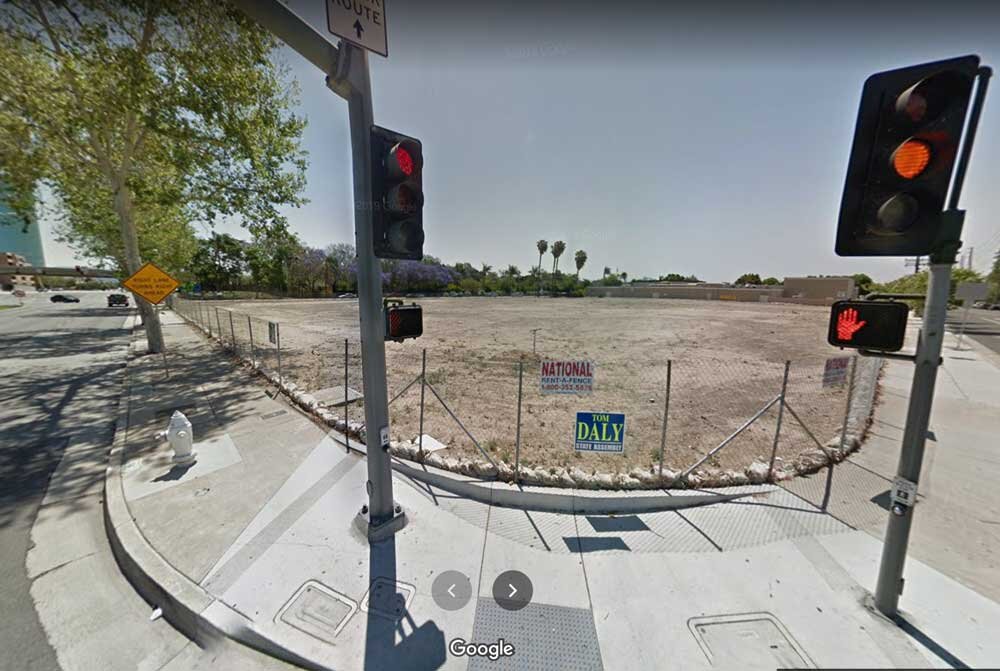
Receivership under the California Health and Safety Code offers communities another tool to abate nuisance conditions at both properties with a high risk of fire, and those already damaged and in need of repair. Get an idea of how these cases work by reading some profiles of projects we’ve completed in this area.
How a Health and Safety Receivership Can Lower the Risk of Fire
The receivership can clear fire hazards and create defensible space on the exterior of the property.
From day one, the receivership can begin working on clearing the dangerous conditions.
Interior dangers including improper storage of hazardous materials, electrical issues, and hoarding can be remedied through receivership.
Since a receivership property pays its costs of repair, taxpayer funds are not used to cure private-property nuisance conditions.
Long-term change can be achieved through a health and safety receivership as the receiver works with the court to determine the best plan for the property and parties involved.
Properties at High Risk of Fire in Receivership

After our initial inspection, C.R.G. deemed the house uninhabitable and we worked with a local social worker and family members to relocate the residents to an assisted living facility to receive the proper care that they needed. With the receivership remedy in place, C.R.G. was able to clean up and rebuild the property into a beautiful single-family home. The property was sold to an owner who proved that they were capable of maintaining the home and the remaining sale proceeds were given to the original owners for their ongoing care.

In the 9 years prior to our appointment, local code enforcement tried to work with the owners of this motel to fix the 203 separate violations of state housing law onsite. There was a complete lack of maintenance of the property, demonstrated by the jet-black water in the swimming pool. The conditions at the motel were so severe that they actually sparked a fire. The fire caused considerable damage to a neighboring property, where it burned out and destroyed a business that had been operating at that location for over 35 years. This case is evidence of the significant danger that violations of municipal and state health and safety laws pose to the surrounding community.

Originally built over a century ago, poor maintenance left this beautiful, Folk Victorian style home in a state of extreme disrepair. After seven years of local code enforcement efforts to encourage the owners to act on fixing the hazardous issues onsite were unsuccessful, we were appointed as the Receiver by a Superior Court Judge. We found the property structurally unsound, with hoarding conditions inside the house, as well as a major rodent and insect infestation. Neighbors were plagued by foul odors emanating from the property and accumulated junk, as well as overgrown landscaping, littered the exterior of the property leaving an eyesore that partially blocked the public sidewalk. We determined that the best cause of action was to renovate this historic property and remove the dangerous conditions.

Although we’ve performed major renovations both before and since, this particular scenario made demolition the most feasible option. The continued negligence from the owners plus the comparatively low cost of leveling versus restoring allowed us to give the property a new beginning from the ground up. Once we had cleaned out the property and safely disposed of the hazardous material, we gave the City’s fire department the opportunity to use the property for a practice drill and training exercise, including a controlled burn—a fitting reversal of the property’s initial status as a fire hazard.

Once the pinnacle of its block, this property boasted exceptional craftsmanship and captivating grounds featuring trees bearing grapefruit, avocados, pecans, and oranges. But decades later, it had fallen into the hands of a compulsive hoarder whose mental illness included the acquisition of an estimated 40-80 cats that roamed the property; they used dirt in the basement as a litter box and the acrid smell proved overwhelming to inspectors. Even after initial cleanups, the stench permeated the property, particularly following rainfall that dampened the basement. The original builder’s niece, married at the property in 1972, burst into tears when she saw the extent of its demise.

Originally built over a century ago, poor maintenance left this beautiful, Queen Anne style home in a state of extreme disrepair. After seven years of local code enforcement efforts to encourage the owners to act on fixing the hazardous issues onsite were unsuccessful, we were appointed as the Receiver by a Superior Court Judge. We found the property structurally unsound, with hoarding conditions inside the house, as well as a major rodent and insect infestation. Neighbors were plagued by foul odors emanating from the property and accumulated junk, as well as overgrown landscaping, littered the exterior of the property leaving an eyesore that partially blocked the public sidewalk. We determined that the best cause of action was to renovate this historic property and remove the dangerous conditions.

A quiet neighborhood was plagued by a property owner who was operating an illegal junkyard across 12 residential lots. Shipping containers and other debris were used to fence around some of the properties, partially concealing numerous items including inoperable vehicles, shopping carts, tires, old appliances, and scrap metal. The majority of lots were vacant, but one lot had a single-family home in poor condition on it where debris was stacked up against it and junk strewn throughout the exterior. Another lot contained a burned-out structure that was not fit for human habitation, but which was occupied in some capacity. In addition to these hazardous conditions, occupants had trailed extension cords through windows to get electricity from one area of the property to another.

It was almost impossible to see this home from the street. Overgrown, dry, and dead vegetation surrounded the house, closing in on the structure. Junk and inoperable vehicles crowded both the front and back yards, and the property was out of place in the clean, quiet neighborhood. But the visual blight was not the only issue that this property presented to this community.

After over two years of enforcement efforts to get the owner of this property to bring their home into compliance, the municipality red-tagged the house deeming it unfit for habitation due to the conditions onsite. Issues included no electricity or running water, piles of junk, evidence of pest infestation, human waste, unmaintained landscaping, and structural inadequacy.

A menace to the local community, this 52-unit mobile home park was left to rot by those who were legally responsible for it, including its owner and the lenders who financed it. Years passed where the park existed in anarchy, with no one in place to ensure it was operating in compliance with local and state health and safety laws. During this time the park subsisted under perilous conditions, which endangered the lives of residents and the surrounding community. The onsite violations of health and safety codes were so severe that the park lost its operating permit, yet occupants continued to live in unsafe, dangerous and unregistered units onsite, in violation of multiple laws.

CRG was appointed to abate the nuisance conditions at this single-family home after multiple instances of unpermitted construction were discovered along with other dangerous conditions so severe that the municipality issued a red-tag for the property. Yet, the owner and their associates ignored the red-tag and continued to reside in the property, using a generator and unsafe electrical wiring to get power inside.

Given its location in a college town, we were surprised to find that this property had extreme hoarder conditions. Items were strewn about in piles that in some cases touched the ceiling. Every available surface was utilized and even the rats had died. The house appeared to have been deserted and there were signs that squatters had broken in and resided inside. The accumulation of debris was a significant fire hazard in addition to the degradation of the structure from lack of maintenance. We were able to completely rehabilitate this property, clean it out and fix the violations of state and municipal health and safety codes.

As a result of poor maintenance and unlawful home renovations, where a beautiful American Craftsman style home had stood for decades, we were appointed as the Receiver of this property as it had fallen into significant disrepair. Broken, littered with trash, and the exterior space housing illegal trailers, the home was a sore point within its quiet, charming neighborhood. Constructed in 1913, one of the first homes built in the town, the degradation of the property was especially apparent given its location next door to the city’s historical society.

This abandoned house was in very poor condition when we were appointed. Not only was there an accumulation of junk and debris, faulty electrical wiring and inadequate plumbing, but the roof was also severely damaged and there was an extensive leak. The exposed roof, combined with the lack of ceiling and wall insulation in parts of the structure, meant that it was riddled with mold and dry rot, which also compromised the structural integrity of the building and it was at risk of collapse.
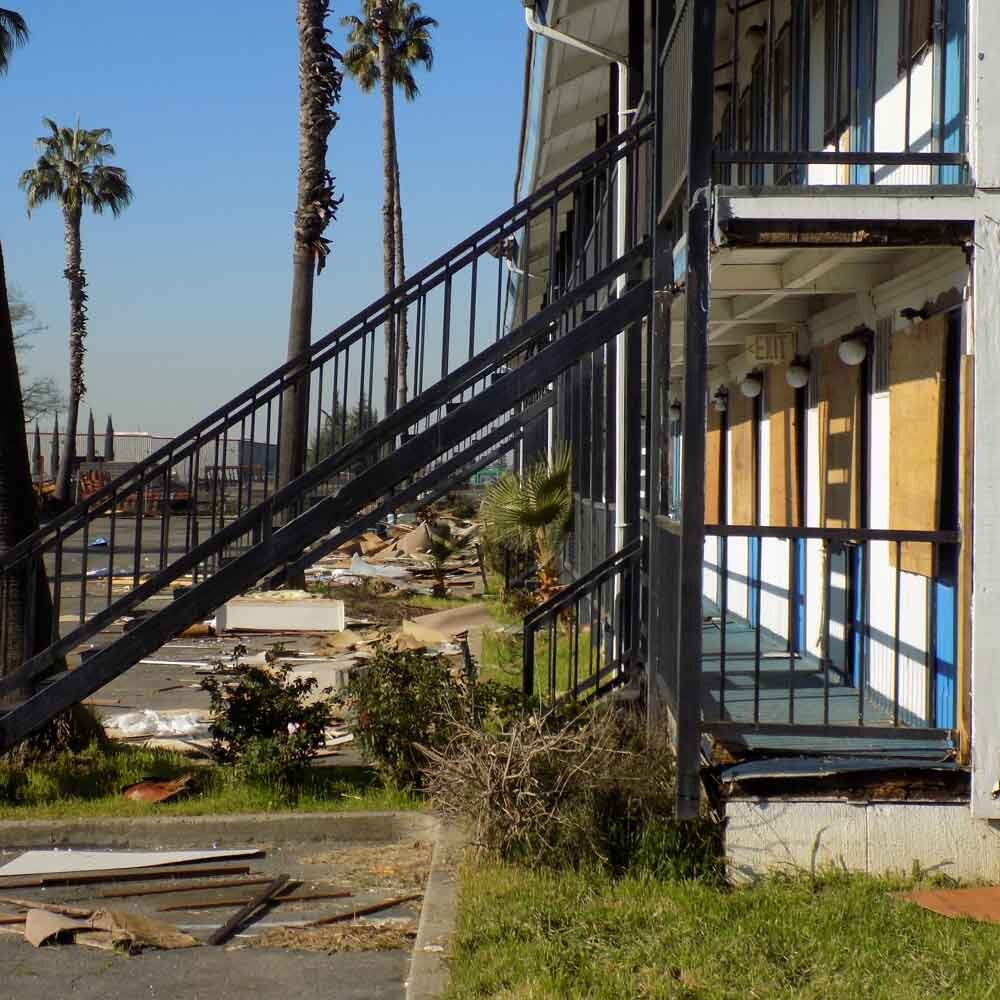

What was intended to be an elegant home, sat as an unfinished construction site for over two decades. Work that had been started in the 1990s was nowhere near completion in 2018 when we arrived onsite following our appointment by the Superior Court. Significant problems included the unsafe storage of building materials, with some stacks over five feet in height, visible from the exterior and stacked against a neighboring property. Alarmingly, inside the house, overhead open beams were used to store large building materials. Further problems were the unfinished electrical work and an unfinished staircase, which was in use, as well as numerous exposed door frames, and visible signs of water damage across the two stories due to a leak.

When the street on which this property is located saw dwindling visitors following the construction of Interstate 5, many businesses in the area closed their doors, abandoning the buildings that housed them. With a building use that has low demand, a property can devolve into nuisance conditions, as happened in this case. See how CRG is making changes through health and safety receivership.
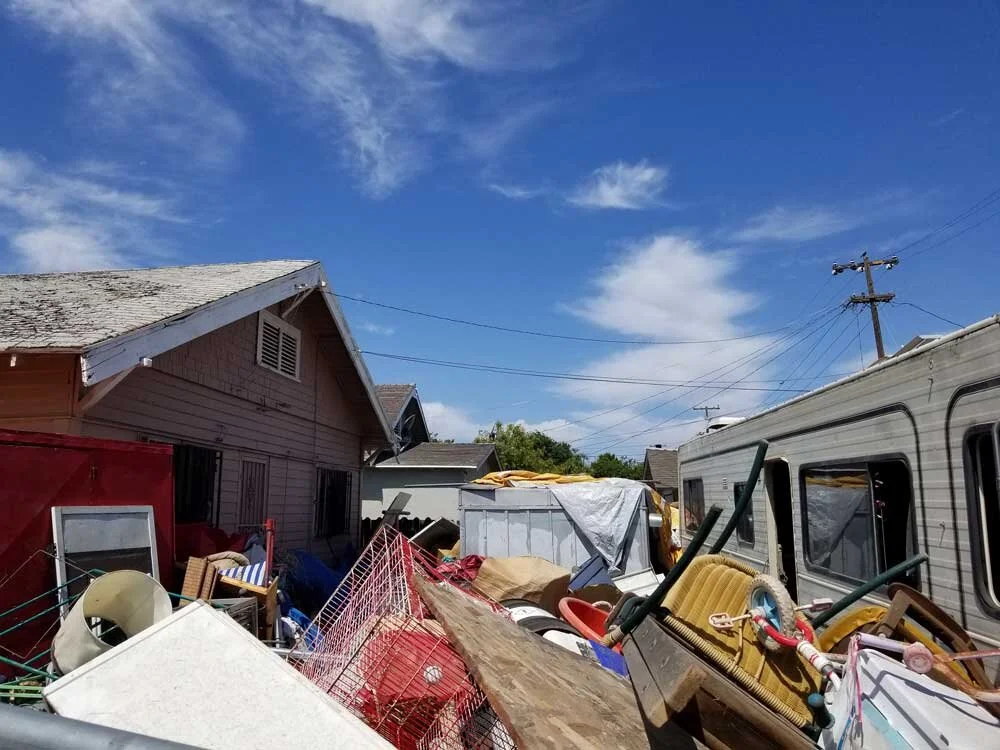
This single-family home suffered from extreme hoarding and associated health and safety issues as the owner and occupants struggled to maintain it with the huge surplus of items crowding the space. From the outside, items were visible throughout the front yard and on the front porch. The back yard was completely inaccessible due to the accumulation of scrap metal, junk, and an inoperable RV.

With structural deficiencies including holes in the floors, walls, and ceilings, this building was dangerous to enter. Yet, broken windows, overgrown landscaping, and an accumulation of junk and debris visible from the street made it an attractive nuisance and it was continuously broken into, adding further problems for people living in the surrounding community. After seven years of code enforcement attempts to get the owner to address the conditions were unsuccessful, CRG was appointed by the superior court to takeover the property and create an abatement plan.

This project involved a property with two separate single-family homes on a large parcel of land. At the time of our appointment, both structures suffered from numerous health and safety code violations. There was extreme hoarding on-site as well as severely unsafe electrical wiring, endangering not only this property and its occupants, but neighboring properties as well. Piles of items blocked doorways and walkways, sometimes reaching the ceiling. Nearly every room had ropes and electrical wires pulled across them, creating walking hazards as well as further illustrating the pervasive fire risk.

We were appointed to tackle the extreme amount of items stored inside this single family home. Hoarding is usually also associated with property degradation as the surplus of belongings make it difficult to clean the property or take care of any homeowner issues that arise with normal wear and tear. Combined with the fact that the large number of items themselves can damage a building, not properly maintaining it is a recipe for greater and greater deterioration that can culminate in significant structural damage. This property was no exception and, as the Court Appointed Health and Safety Receiver, we found structural deficiencies so severe that the building needed to be demolished.

Officials in a northern California County, prone to dangerous wildfires, contacted CRG after a property owner within its boundaries refused to address serious code violations at their home. Infractions included masses of dried leaves, accumulated junk, and dead shrubbery surrounding the property. Most significant were six large, dead trees, which were clumped together, leaning directly against the house. The unmaintained landscaping had the potential to magnify even a small fire, with the trees providing a potential ladder, helping to push any fire up and into the house. All that was needed for the unkempt property to turn deadly was the strike of a match, or a spark of wildfire. This would have endangered not only the owner, but neighboring properties, as well; the problems on-site reached far across the lot, enabling any fire to spread to the neighborhood.
How a Health and Safety Receivership Can Help Clear a Burned Structure
Receivership can bring lasting change to a nuisance property.
Through receivership, a property pays its own repair costs, meaning that these are not the responsibility of the taxpayers in the surrounding community.
The property can be secured on day one of an appointment.
The property can be cleaned and assessed shortly thereafter.
Depending on the unique situation, the receivership would abate the issues, or could find a responsible owner who commits to doing so within a set period of time (usually 6 months).
Not all fire damaged properties have to be demolished. We have seen extremely dilapidated properties restored and are always cautious before determining to demolish a structure as we view demolition as an absolute last resort.
Fire Damaged Properties in Receivership

A property deteriorated from an upscale establishment into a public nuisance. When the nuisance conditions were finally remedied, space was created for the property's redevelopment. While most would not have anticipated the decline of this once popular and prestigious establishment, the story is familiar to CRG. It shows just how effective health and safety receivership can be at remedying nuisance properties and initiating a ripple effect for revitalization efforts.
A quiet neighborhood was plagued by a property owner who was operating an illegal junkyard across 12 residential lots. Shipping containers and other debris were used to fence around some of the properties, partially concealing numerous items including inoperable vehicles, shopping carts, tires, old appliances, and scrap metal. The majority of lots were vacant, but one lot had a single-family home in poor condition on it where debris was stacked up against it and junk strewn throughout the exterior. Another lot contained a burned-out structure that was not fit for human habitation, but which was occupied in some capacity. In addition to these hazardous conditions, occupants had trailed extension cords through windows to get electricity from one area of the property to another.
After over two years of enforcement efforts to get the owner of this property to bring their home into compliance, the municipality red-tagged the house deeming it unfit for habitation due to the conditions onsite. Issues included no electricity or running water, piles of junk, evidence of pest infestation, human waste, unmaintained landscaping, and structural inadequacy.

When we were appointed to address the nuisance conditions at this property, we found that it had suffered extensive fire damage and was severely deteriorated. Structurally unsound, it had gaping holes in the floors, walls, and roof. The structural failure extended to the foundation and the building was partially collapsing in places, rendering it extremely hazardous to be onsite and unfit for habitation. Additionally, there was insufficient plumbing and no running water onsite. Piles of trash and debris were littered through the interior and exterior of the property. These included containers of decaying matter, clothing and used rags, sofas, mattresses, a boat, and a jet ski, as well as inoperable vehicles.

Although this property was the subject of municipal health and safety code enforcement efforts, the owners were uncooperative with officials and failed to remedy the violations of local and state laws. Years passed and the house languished in a dilapidated state until it was sadly engulfed by an electrical fire. Unfortunately, a friend of the owner was living in the attic at the time and tragically suffocated in the fire.

Fire damaged, structurally unsound and at risk of collapsing, this property was in very poor condition when we were appointed as the Receiver and it was dangerous to be onsite. The structure was full of trash, infested with pests, lacking electricity, heating, and running water. We have been able to completely remodel the structure and abate the numerous violations of municipal and state health and safety codes on the property.

Over fifteen years of municipal code enforcement efforts yielded no results in gaining the owner’s compliance to remedy the issues afflicting this nuisance property in Alameda County. In fact, conditions only worsened as the home became the subject of a fire and multiple break-ins. Each time the house was broken into, it was the City who had to expend precious municipal resources to board up and secure the home. The fire made the property more dangerous and increased the likelihood that the structure would collapse. Nevertheless, transients continued to squat inside the house and it became a major source of crime and blight in the neighborhood. Through a health and safety receivership, the dangerous issues on-site were abated and the future of the property secured.
